

Building bone strengh in runners
What can we supplement for runners to improve their bone health?
Unfortunately, running is seen as a sport or training modality that increases the resilience and capacity of the bones of the body. Although this does hold some truth, the amount is minimal compared to what could be achieved.
As you can see below, gymnastics was found to be a high bone building activity while we see running categorised as a low osteogenic stimulus.
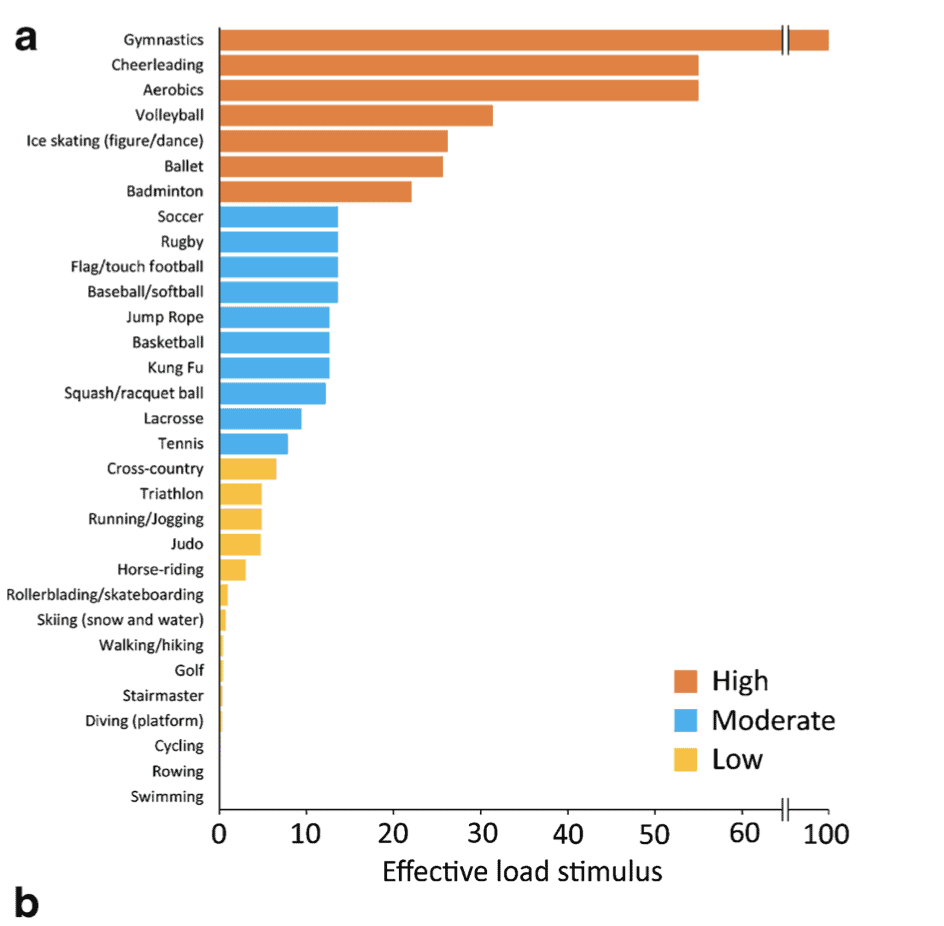
Several high-quality reviews have shown that increasing running volume with the intention of enhancing bone health is an uphill battle and that:
- Lifting heavy weights and/or
- Maximal jump training improves bone health in pre-menopausal athletes.
Using these modalities can create a buffer when training load increases. Further, the body isn’t subject to the strain that running entails while still gaining benefit.
With consistent training, school and commitments, training time can be sensitive. So, which is most likely to cause an osteogenic, or ‘bone-building response’?
Firstly, either will achieve increased bone resilience. Simply, this happens as the loads from either of these modalities are greater than those of running. Further, as the repetitions are lower, the risk of accumulating bone damage is lower compared to say a 5km or 10km run.
So, let’s look at the studies that performed the training:
Study 1 looked at 4 sets of fast and heavy squats.
3-5 reps @ 85-90% of their 1 rep max.
12-weeks, 3 times a week.
Results of bone mineral density (BMD) after:
2.2% increase in Lumbar Spine in BMD
1% increase in femoral neck in BMD
Study 2 looked at doing 20 jumps, 3 times a day for 6 months with a vest (0-5kg in weight)
Results of bone mineral density (BMD) after:
4.6% increase in Lumbar Spine in BMD
9.8% increase in femoral neck in BMD
So, what does all this mean and what are the take always?
- Jump training is better for the legs & hip, lifting heavy weights is better for the spine. A program that uses both is probably best.
- Both training styles in conjunction with running is an easy and effective way to enhance bone health
- These modalities can be done at home, gym or even in the park so it’s a worthwhile investment
Podcast by Professor Stuart Warden on all things Bone Stress injuries
Resources to further understanding:
https://thephysicalperformanceshow.libsyn.com/the-physical-performance-show-217
https://www.instagram.com/achievepodiatry/
References:
Baxter-Jones AD, Faulkner RA, Forwood MR, Mirwald RL, Bailey DA (2011) Bone mineral accrual from 8 to 30 years of age: an estimation of peak bone mass. J Bone Miner Res 26(8):1729–1739.
Martyn-St James M, Carroll S. Effects of different impact exercise modalities on bone mineral density in premenopausal women: a meta-analysis. J Bone Miner Metab. 2010 May;28(3):251-67. doi: 10.1007/s00774-009-0139-6. Epub 2009 Dec 15. PMID: 20013013.
Mosti, Mats P.1; Carlsen, Trude2; Aas, Elisabeth2; Hoff, Jan2,3; Stunes, Astrid K.1; Syversen, Unni1,4 Maximal Strength Training Improves Bone Mineral Density and Neuromuscular Performance in Young Adult Women, Journal of Strength and Conditioning Research: October 2014 - Volume 28 - Issue 10 - p 2935-2945 doi: 10.1519/JSC.0000000000000493

Blake Withers
More Articles
Step Up Your Foot Health knowledge with the your local Newcastle Podiatrist: Achieve Podiatry
Looking for relief from foot or heel pain in Newcastle? Our blog discusses the effectiveness of injections in improving foot function and reducing pain. While all studies had a high risk of bias, our analysis shows that DPT resulted in short-term improvements in pain and foot function compared to control groups, including exercises and placebo. As a trusted Newcastle podiatrist, we offer personalized treatment plans to help you achieve long-term relief from foot pain.
Score a Goal Against Groin Injuries: The Adductor Strengthening Programme for Football Players!
Male football players frequently get groyne injuries, which make up a sizable portion of time-loss injuries. According to a recent study, football players’ chances of experiencing groyne issues might be greatly decreased by adding only one exercise to their adductor strengthening regimen. A straightforward exercise from the Adductor Strengthening Plan can be integrated into routine warm-ups. In both the ITT and PP analyses, the programme decreased the prevalence of groyne issues by 41% and 47%, respectively. The findings imply that the ASP should be incorporated into senior male football players’ training, and it might also be advantageous for athletes in other sports with comparable movement patterns.
Protect Your Run: How Strength Training Can Reduce the Risk of Running Injuries
At Achieve Podiatry, we understand the importance of strength training in preventing running injuries. As experienced Newcastle podiatrists, we have seen first hand the impact that a lack of strength in certain muscles can have on a runner’s performance and overall foot health. In this blog, we will dive into the science behind why strength training is crucial for reducing the risk of running injuries, and provide tips and exercises to help runners incorporate strength training into their routine.
Rev Up Your Recovery: How to Rehab Your Hamstring Like a Pro
Are you dealing with a nagging hamstring injury that just won’t seem to heal? You’re not alone. Hamstring injuries are common among athletes and active individuals, and can be frustrating to deal with. But don’t despair – with the right rehabilitation techniques and a commitment to consistency, you can get your hamstring back to full strength and function. In this blog post, we’ll go over some of the most effective exercises and strategies for rehabilitating your hamstring injury and getting you back to the activities you love
How does our psychological health play into pain, especially heel pain
When it comes to heel pain, it’s important to understand that our psychological health plays a significant role in our experience of pain. Studies have shown that factors such as pain catastrophizing, a tendency to magnify the threat value of pain stimuli, and depressive symptoms are all prevalent in individuals with heel pain. In fact, research has found that these psychological factors can account for up to 40% of the variance in patients’ heel pain, even before a formal orthopedic diagnosis is made.
This is not to say that physical causes of heel pain, such as plantar fasciitis or heel spurs, should be ignored. Rather, it highlights the importance of considering the psychological and emotional factors that may be contributing to the severity and persistence of heel pain. By addressing these factors in addition to providing orthopedic treatment, we can help patients achieve better outcomes and improve their overall quality of life.
It’s important for health professionals to recognize the role of psychological factors in pain, especially in heel pain. It’s not just about the physical treatment but also addressing the emotional and mental side of the pain. To effectively manage heel pain, healthcare professionals should work with patients to identify and address psychological and emotional factors that may be exacerbating their pain, in addition to providing traditional orthopedic treatment.
Injections in Achilles and Patellar Tendinopathy
Achilles and patellar tendinopathy are prevalent conditions among populations exposed to frequent mechanical loading. They typically take a long time to get better, with some studies showing up to 40% of people have continuing symptoms 5 years later. Best practice management has progressive loading within a pain monitoring framework at its core.
Is there an association between occupation, footwear and osteoarthritis of the big toe joint?
“There were no statistically significant associations between lifetime occupation type and the presence of ROA of the first MPJ” Cherry, L. Gates, N. K. Arden & C. J. Bowen The study aim was to determine whether lifetime occupation was associated with the presence of radiographic osteoarthritis (ROA) of the first metatarsophalangeal joint (MTPJ) in women.…
Bone Stress Injuries in Runners with Next Gen Physio
If you haven’t already – head over to Next Gen Physio’s website to read part 1. Now you know everything you can do to work around bone Stress injuries. How can we get back running? It is incredibly important that your return to running (RTR) is guided by evidence-based concepts that are easily implemented. Easy…
Heel and Foot Pain? Read and Fix it now!
Heel pain is the most common foot condition on earth. We see it the most out of all podiatrist in Newcastle as we are a speciality clinic. This blog details some of the treatments we may use and how we use them.
Does it matter if your kids lower limb looks different?
This blog explains how important it is to worry about kids feet and their lower limb. Feet rolling in and knee’s going is normal.