

Building bone strengh in runners
What can we supplement for runners to improve their bone health?
Unfortunately, running is seen as a sport or training modality that increases the resilience and capacity of the bones of the body. Although this does hold some truth, the amount is minimal compared to what could be achieved.
As you can see below, gymnastics was found to be a high bone building activity while we see running categorised as a low osteogenic stimulus.
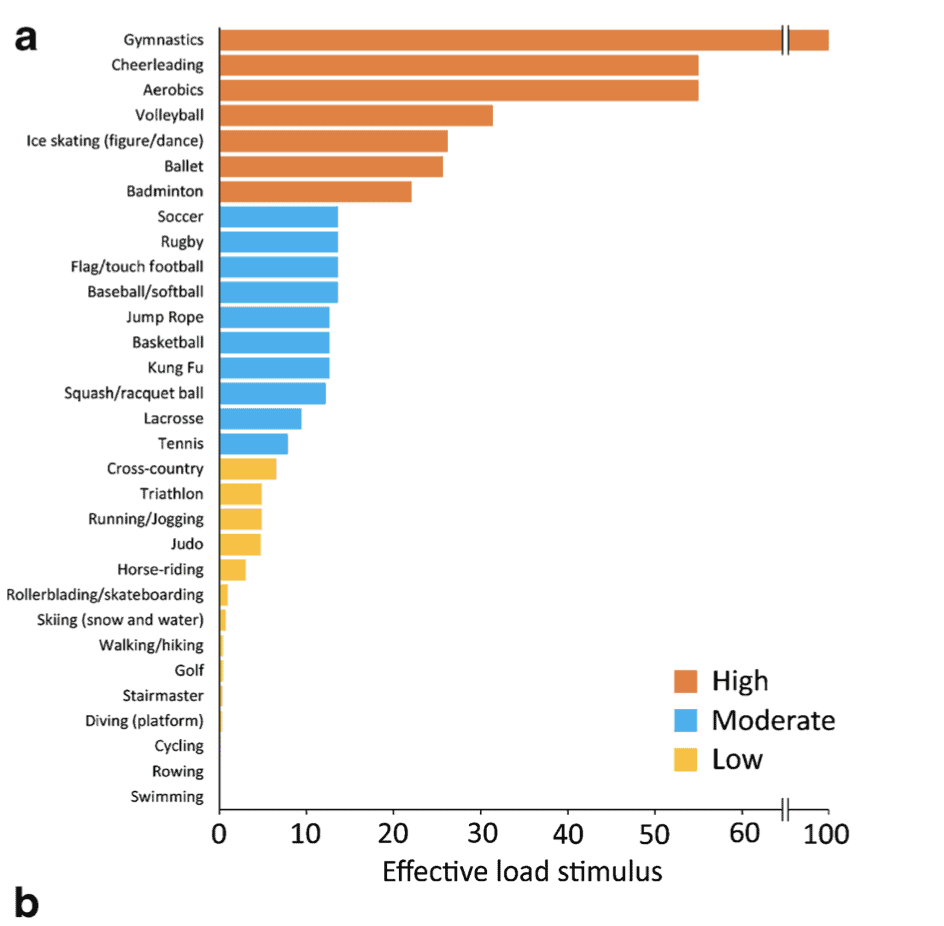
Several high-quality reviews have shown that increasing running volume with the intention of enhancing bone health is an uphill battle and that:
- Lifting heavy weights and/or
- Maximal jump training improves bone health in pre-menopausal athletes.
Using these modalities can create a buffer when training load increases. Further, the body isn’t subject to the strain that running entails while still gaining benefit.
With consistent training, school and commitments, training time can be sensitive. So, which is most likely to cause an osteogenic, or ‘bone-building response’?
Firstly, either will achieve increased bone resilience. Simply, this happens as the loads from either of these modalities are greater than those of running. Further, as the repetitions are lower, the risk of accumulating bone damage is lower compared to say a 5km or 10km run.
So, let’s look at the studies that performed the training:
Study 1 looked at 4 sets of fast and heavy squats.
3-5 reps @ 85-90% of their 1 rep max.
12-weeks, 3 times a week.
Results of bone mineral density (BMD) after:
2.2% increase in Lumbar Spine in BMD
1% increase in femoral neck in BMD
Study 2 looked at doing 20 jumps, 3 times a day for 6 months with a vest (0-5kg in weight)
Results of bone mineral density (BMD) after:
4.6% increase in Lumbar Spine in BMD
9.8% increase in femoral neck in BMD
So, what does all this mean and what are the take always?
- Jump training is better for the legs & hip, lifting heavy weights is better for the spine. A program that uses both is probably best.
- Both training styles in conjunction with running is an easy and effective way to enhance bone health
- These modalities can be done at home, gym or even in the park so it’s a worthwhile investment
Podcast by Professor Stuart Warden on all things Bone Stress injuries
Resources to further understanding:
https://thephysicalperformanceshow.libsyn.com/the-physical-performance-show-217
https://www.instagram.com/achievepodiatry/
References:
Baxter-Jones AD, Faulkner RA, Forwood MR, Mirwald RL, Bailey DA (2011) Bone mineral accrual from 8 to 30 years of age: an estimation of peak bone mass. J Bone Miner Res 26(8):1729–1739.
Martyn-St James M, Carroll S. Effects of different impact exercise modalities on bone mineral density in premenopausal women: a meta-analysis. J Bone Miner Metab. 2010 May;28(3):251-67. doi: 10.1007/s00774-009-0139-6. Epub 2009 Dec 15. PMID: 20013013.
Mosti, Mats P.1; Carlsen, Trude2; Aas, Elisabeth2; Hoff, Jan2,3; Stunes, Astrid K.1; Syversen, Unni1,4 Maximal Strength Training Improves Bone Mineral Density and Neuromuscular Performance in Young Adult Women, Journal of Strength and Conditioning Research: October 2014 - Volume 28 - Issue 10 - p 2935-2945 doi: 10.1519/JSC.0000000000000493

Blake Withers
More Articles
Calf tears
Calf injury’s The calf muscle is one of the most commonly ‘torn’ or ‘strained’ muscles in the body. This occurs when the muscle is forcibly stretched beyond its limits resulting in tearing of some of the muscle fibres. The calf is comprised of two muscles. The Soleus which is deep and the…
Shockwave therapy
Shockwave therapy What is shockwave therapy? Do I need shockwave therapy? My friend has shockwave therapy and it didn’t work? Does shockwave therapy hurt? We will look to answer some of these questions over the coming weeks through our instagram and blogs We have it and yes, we use it. Does that mean…
Stretching is good… isn’t it?
Do I need to stretch? Is stretching worth while?
One leg shorter than the other?
Limb Lengh Differences What is a Limb Length Difference? Having one leg shorter than the other. Although it is well acknowledged there is a high prevalence of it amongst people, there is little consensus amongst literature as to the significance or the importance of it. Causes: Congenital (from birth) conditions include mild developmental abnormalities found…
Return to Running with your Newcastle Podiatrist
This is a short summary of how to to return to running after an injury. We see many runners in clinic and use this a tool they can use when returning.
Sports Podiatry in Australia
What is sport Podiatry? Is there a difference between a podiatrist and a sports podiatry. What about podiatrists that predominantly see sport injuries?
Bone stress injuries in prepubescent athletes
What can we supplement for runners to improve their bone health?
Unfortunately, running is seen as a sport or training modality that increases the resilience and capacity of the bones of the body. Although this does hold some truth, the amount is minimal compared to what could be achieved.
Myths About Foot Orthoses
Foot orthoses, otherwise referred to as foot orthotics are specially designed shoe inserts that help redistribute forces throughout the lower limb. Blake has provided some insight on what foot orthoses really are and has helped to bust common foot orthoses myths.
- « Previous
- 1
- …
- 3
- 4
- 5