

Building bone strengh in runners
What can we supplement for runners to improve their bone health?
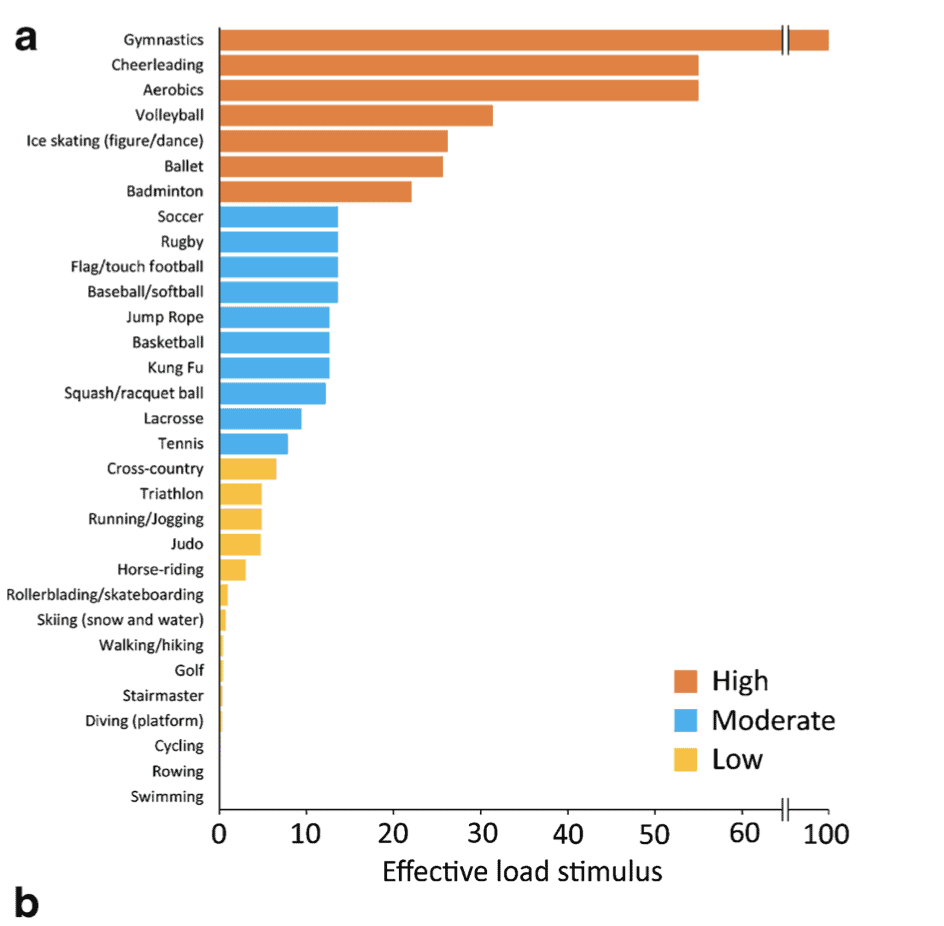
Unfortunately, running is seen as a sport or training modality that increases the resilience and capacity of the bones of the body. Although this does hold some truth, the amount is minimal compared to what could be achieved.
As you can see below, gymnastics was found to be a high bone building activity while we see running categorised as a low osteogenic stimulus.
Several high-quality reviews have shown that increasing running volume with the intention of enhancing bone health is an uphill battle and that:
- Lifting heavy weights and/or
- Maximal jump training improves bone health in pre-menopausal athletes.
Using these modalities can create a buffer when training load increases. Further, the body isn’t subject to the strain that running entails while still gaining benefit.
With consistent training, school and commitments, training time can be sensitive. So, which is most likely to cause an osteogenic, or ‘bone-building response’?
Firstly, either will achieve increased bone resilience. Simply, this happens as the loads from either of these modalities are greater than those of running. Further, as the repetitions are lower, the risk of accumulating bone damage is lower compared to say a 5km or 10km run.
So, let’s look at the studies that performed the training:
Study 1 looked at 4 sets of fast and heavy squats.
3-5 reps @ 85-90% of their 1 rep max.
12-weeks, 3 times a week.
Results of bone mineral density (BMD) after:
2.2% increase in Lumbar Spine in BMD
1% increase in femoral neck in BMD
Study 2 looked at doing 20 jumps, 3 times a day for 6 months with a vest (0-5kg in weight)
Results of bone mineral density (BMD) after:
4.6% increase in Lumbar Spine in BMD
9.8% increase in femoral neck in BMD
So, what does all this mean and what are the take always?
- Jump training is better for the legs & hip, lifting heavy weights is better for the spine. A program that uses both is probably best.
- Both training styles in conjunction with running is an easy and effective way to enhance bone health
- These modalities can be done at home, gym or even in the park so it’s a worthwhile investment
Podcast by Professor Stuart Warden on all things Bone Stress injuries
Resources to further understanding:
https://thephysicalperformanceshow.libsyn.com/the-physical-performance-show-217
https://www.instagram.com/achievepodiatry/
References:
Baxter-Jones AD, Faulkner RA, Forwood MR, Mirwald RL, Bailey DA (2011) Bone mineral accrual from 8 to 30 years of age: an estimation of peak bone mass. J Bone Miner Res 26(8):1729–1739.
Martyn-St James M, Carroll S. Effects of different impact exercise modalities on bone mineral density in premenopausal women: a meta-analysis. J Bone Miner Metab. 2010 May;28(3):251-67. doi: 10.1007/s00774-009-0139-6. Epub 2009 Dec 15. PMID: 20013013.
Mosti, Mats P.1; Carlsen, Trude2; Aas, Elisabeth2; Hoff, Jan2,3; Stunes, Astrid K.1; Syversen, Unni1,4 Maximal Strength Training Improves Bone Mineral Density and Neuromuscular Performance in Young Adult Women, Journal of Strength and Conditioning Research: October 2014 - Volume 28 - Issue 10 - p 2935-2945 doi: 10.1519/JSC.0000000000000493

Blake Withers
More Articles
Could a Carbon Plate be Your New Best Mate?
Putting something hard and stiff into your shoe doesn’t sound all that comfortable when you have an injured foot, does it? So how, in the Foot God’s name, is this hard plate going to make your foot feel better? The answer: Put simply- reduce the bending forces on your injured foot. When we…
Forefoot Taping: Relief for Plantar Plate, Capsulitis, Neuroma, and Morton’s Neuroma aPain
Unlock relief for forefoot pain! Learn essential taping techniques to address plantar plate injury, capsulitis, neuroma, and Morton’s neuroma. Expert tips to keep you moving pain-free! #FootHealth #TapingTechniques
Low Dye TapeModified Low-Dye Taping for Plantar Fasciitis and other foot pain conditions
Discover the benefits of Modified Low-Dye Taping for common foot conditions like plantar fasciitis, tibialis posterior tendinopathy, heel pain, and midfoot arthritis. Learn how this simple taping technique can provide relief and support for various foot pathologies.
Introducing Port Macquarie’s Experienced Podiatrist, Cameron Liles, to Achieve Podiatry
Welcome to our blog post where we’re excited to introduce Cameron Liles, our experienced podiatrist, who has recently joined the team at Achieve Podiatry in Port Macquarie. With over six years of diverse experience in the Central West of NSW, Cameron brings a wealth of knowledge and a dedication to providing comprehensive foot care to our community. From evidence-guided treatment plans to specialized expertise in footwear advice, orthotic therapy, and exercise-based solutions, Cameron is committed to helping individuals of all ages and backgrounds achieve optimal foot health and return to an active, pain-free lifestyle. Join us in welcoming Cameron to Achieve Podiatry as we continue our mission of delivering exceptional care to our patients.
The Wrap Protocol for Managing Achilles Tendonitis and Peritendonitis
Unlock Optimal Foot Health: The Wrap Protocol for Achilles Tendonitis and Peritendonitis
Embark on a journey to unparalleled foot well-being with our specialized approach – The Wrap Protocol. Crafted by podiatric experts, this protocol is your definitive guide to conquering Achilles Tendonitis and Peritendonitis. Delve into a wealth of in-depth research and gain practical insights tailored for your unique foot concerns.
Why Choose The Wrap Protocol?
Elevate your foot care journey with The Wrap Protocol – where expertise meets personalized healing. Unleash the potential of your feet, step into comfort, and stride towards lasting foot health.
Exploring Paediatric Podiatry: Foot Care and health for Kids
In our comprehensive blog post, we aim to address common questions and concerns regarding pediatric podiatry—the specialized field of foot care for children. We understand that parents often have inquiries about their child’s foot development, common conditions, and appropriate footwear choices. With expert insights and evidence-based information, we provide valuable guidance to help parents navigate the world of children’s foot health. Whether you’re curious about normal foot milestones, tips for maintaining healthy feet, or identifying signs of potential issues, our blog has you covered. Empower yourself with the knowledge needed to ensure your child’s feet are supported, comfortable, and ready to take each step with confidence.
Decoding Heel Pain: Unraveling Prognostic Factors with Achieve Podiatry
Welcome to the Achieve Podiatry blog, your trusted source for all things related to foot health and well-being. In this article, we will be delving into the intricate world of heel pain and exploring the essential prognostic factors that can help determine its course and outcome. Understanding these factors is crucial in developing effective treatment plans and achieving long-lasting relief. Join us as we unravel the mysteries of heel pain prognosis and gain valuable insights from the experienced team at Achieve Podiatry. Get ready to take a step towards better foot health and a pain-free life.
How Advancement in Bone Science Should Inform the Examination and Treatment of Femoral Shaft Bone Stress Injuries in Running Athletes TAKEAWAYS: Endurance runners (especially female) with a dull ache, made worse with running and better with non-impact activity should be considered to have a bone stress injury unless cleared otherwise. Strength testing, motion testing,…
Can Running Shoes Be the Solution to Patellofemoral Pain?
Patellofemoral pain (PFP) is a common problem among runners, and treating it can be a challenge for clinicians. One promising treatment option that has gained attention in recent years is the use of minimalist running shoes. These shoes have a low profile and minimal cushioning, which are believed to encourage a more natural running gait and reduce the impact forces experienced by the body while running. Could minimalist running shoes be the key to managing PFP?
You don’t want to miss this! Understanding The Complex Midfoot Injury
Midfoot pain can be a debilitating condition that can affect anyone, from athletes to office workers. This type of pain is often felt in the arch of the foot or the middle of the foot and can be caused by a variety of factors, including overuse injuries, stress fractures, and arthritis.